Fear and Identity: What Psychology Says vs. What Scripture Declares
Fear is a liar.
It whispers that failure means rejection. That mistakes make us unlovable. That our worth is measured by what we achieve rather than who we are.
But what if our deepest fears about identity aren’t just psychological struggles—they’re spiritual battles over where we place our belonging?
Today, we’re diving into Part 2 of our series on fear. We will unpack how psychology and Scripture handle the crushing weight of performance-based identity. We will also explore the liberating truth that sets us free.
Fear’s Hidden Agenda: Why Failure Feels Like a Threat
Fear of failure rarely shows up as pure terror. Instead, it disguises itself in behaviors we’ve normalized:
Perfectionism (If I don’t mess up, I won’t be rejected.)
Procrastination (If I don’t try, I can’t fail.)
Over-achievement (If I impress everyone, I’ll be enough.)
Beneath these coping mechanisms lies a raw wound: the belief that failure erases our worth.
Psychology confirms this. Studies link fear of failure to conditional self-worth—a mindset that says: “I am loved only when I succeed.” When our identity is tied to achievement, failure doesn’t just hurt our progress—it attacks our core.
But Scripture offers a radical choice.
Psychology’s Lens: The Shame-Fear Cycle
Clinical research reveals how fear of failure traps us in three toxic patterns:
Shame vs. Guilt
Guilt says, “I did something bad.”
Shame says, “I am bad.”
Fear magnifies shame, making failure feel like a verdict on our identity.
Conditional Love
Many of us internalize messages like:
“You’re only valuable when you act.”
“Mistakes make you disposable.”
This wires our brains to equate achievement with acceptance.
Avoidance or Overwork
We either shut down to avoid risks. Alternatively, we double down by striving relentlessly. We hope to outrun the fear of inadequacy.
The result? A fragile identity—one that crumbles under the weight of imperfection.
Scripture’s Answer: Loved Before We Prove Ourselves
Here’s where the Gospel interrupts fear’s narrative.
“But God demonstrates His own love for us in this: While we were still sinners, Christ died for us.”
— Romans 5:8
This isn’t love earned by achievement. It’s love given in our mess.
When shame says, “You’re unworthy,” God says, “You’re mine.” (Isaiah 43:1)
When fear whispers, “You’ll be rejected,” God declares, “There’s no condemnation.” (Romans 8:1)
When performance demands, “Do more,” grace reminds, “You’re already chosen.” (1 Peter 2:9)
Our identity isn’t built on success—it’s rooted in sonship (Romans 8:15). We don’t fight for worth; we rest in it.
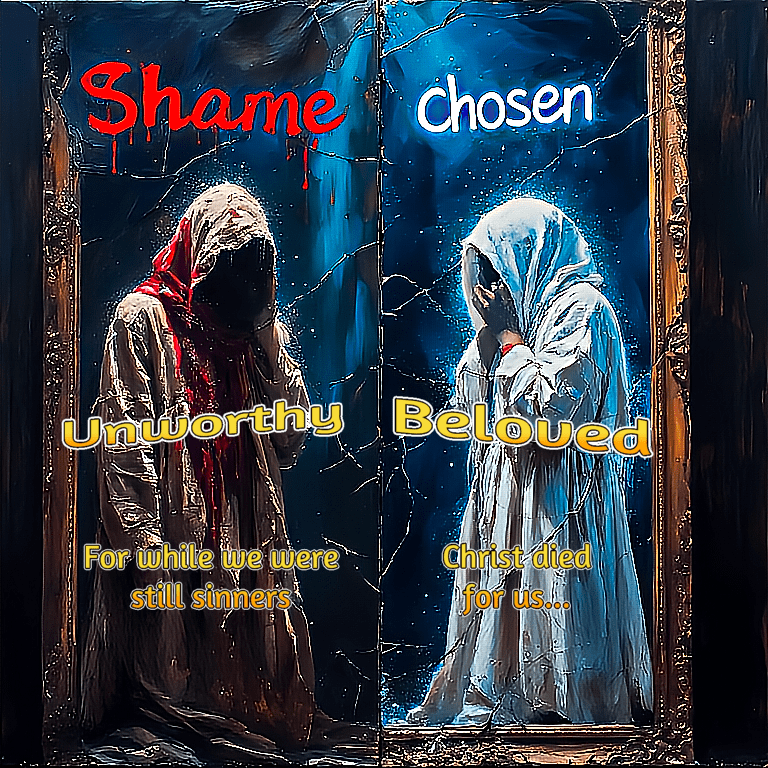
Visualizing the Battle: Shame vs. Beloved
Imagine two mirrors:
The Mirror of Shame:
A figure hidden in shadows, labeled “Unworthy.”
The reflection is fractured, distorted by fear’s lies.
The Mirror of Grace:
A figure standing in light, clothed in white, labeled “Beloved.”
The reflection is whole, unshaken by failure.
Between them stands a threshold—the moment we exchange fear’s narrative for God’s.
The Antidote: Adoption Over Achievement
Fear loses power when we anchor our identity in something unshakable.
You did not receive a spirit of slavery. You will not fall back into fear. Instead, you received the Spirit of adoption as sons.
— Romans 8:15
We aren’t defined by what we do but by whose we are.
Reflection Questions:
When have you felt loved only for your success?
What labels has fear placed on you? (“Failure,” “Disappointment,” “Impostor”?)
How would life change if you lived from belonging instead of performing?
Scriptures to Rewire Your Identity
“I have called you by name; you are mine.”
You belong to me. You are identified in Isaiah 43:1.
“See what great love the Father has lavished on us, that we should be called children of God!” — 1 John 3:1
“You are a chosen people… God’s special possession.” — 1 Peter 2:9
Final Thought:
Fear says, “Prove yourself.”
Grace says, “You’re already loved.”
The path to freedom begins when we stop letting failure define us—and start letting love name us.
You are not what you achieve. You are who God says you are.
Let’s keep the conversation going—drop a comment below: Which verse anchors you when fear attacks your worth?
 The Inner Lens
Leave a comment