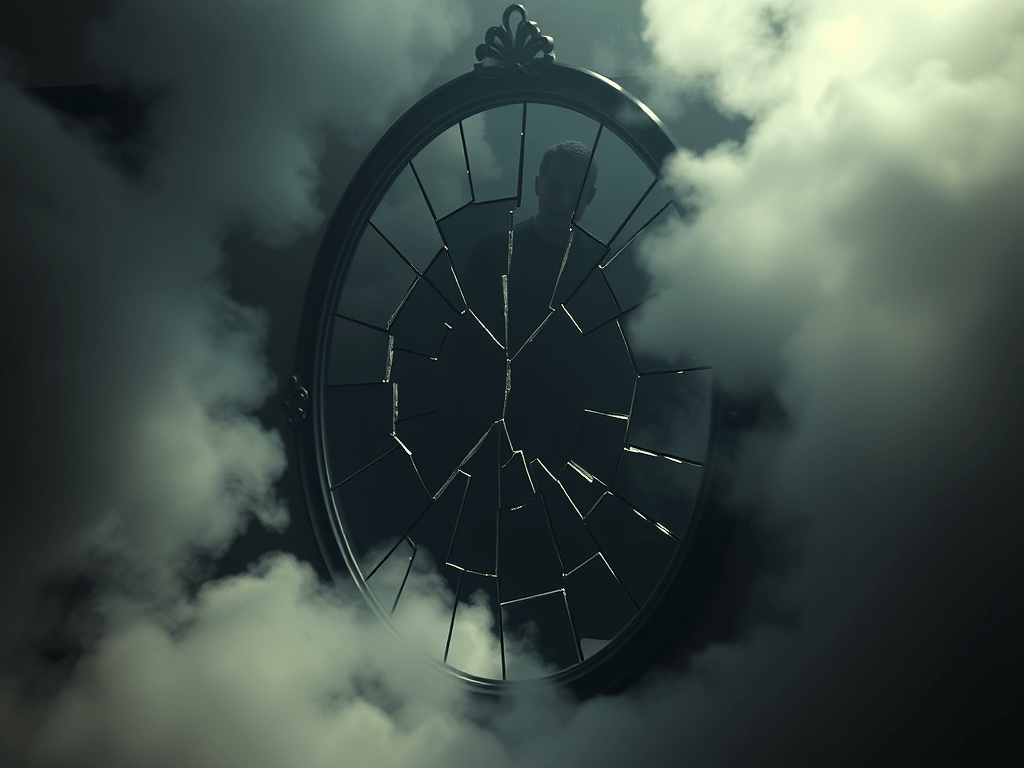
The Mirror Prison: When Faith Becomes Performance
You check your reflection in every screen, every window, every shiny surface you pass. Not out of vanity—out of vigilance. Am I doing this right? Do I look spiritual enough? Can they see through me?
The Apostle Paul had a name for this exhausting performance: φίλαυτοι (philautoi)—lovers of themselves. But he wasn’t describing Instagram narcissists. He identified something far more insidious. It involved people who keep “a form of godliness but deny its power” (2 Timothy 3:5).
Welcome to the Mirror Prison, where you’re both actor and audience in an endless one-person show.
The Architecture of Self-Captivity
Paul’s list in 2 Timothy 3 isn’t random. He begins with self-love because it’s the root system feeding every other dysfunction. When the self becomes its own reference point, everything warps:
- Your worship becomes performance art
- Your relationships become networking
- Your service becomes resume-building
- Your confession becomes image management
The Greek word μόρφωσις (morphosis) that Paul uses for “form” literally means an outward shape—like a mannequin wearing clerical robes. All the right gestures, zero transformative power.
You know this prison. You’ve decorated its walls with certificates of approval, likes and shares, carefully curated testimonies. You’ve installed mirrors at every angle to watch your spiritual performance. But here’s what makes it a prison: you’re so busy watching yourself that you can’t see God.
The Opposite of Kenosis
The escape route isn’t self-improvement—it’s self-emptying. Paul points to Christ who “emptied himself” (Philippians 2:7), not losing his identity but revealing it fully through radical self-giving. This kenosis is the Mirror Prison’s kryptonite.
But here’s where modern believers get stuck: we try to do humility too. We make self-deprecation into another mirror, confession into another stage. We’re so accustomed to the prison we try to redecorate instead of escape.
Breaking the Mirrors
Liberation requires something more radical than better performance. It requires what N.T. Wright calls refusing to propose an anthropology “on its own, self-analyzing, looking at itself in a mirror.” It means:
- Dying to the audience – Whether they applaud or attack, their evaluation no longer defines you
- Embracing hiddenness – Serving where no one sees, praying where no one hears
- Practicing presence – Actually showing up to your life instead of performing it
- Receiving reality – Letting God’s assessment of you override your self-evaluation
The Power You’ve Been Denying
Paul’s phrase haunts: “denying its power.” The δύναμις (dynamis) you’re rejecting isn’t just spiritual electricity—it’s the explosive force that shatters mirrors and rebuilds identities. It’s resurrection power, and it works in the opposite direction of self-monitoring.
The gospel doesn’t give you a better performance. It ends the show entirely.
Instead of checking your reflection, you start reflecting something else—Someone else. The exhausting vigilance relaxes into genuine presence. The carefully managed image crumbles, and something infinitely more real emerges: a person being transformed by encountering actual Love.
The Question That Unlocks the Cell
Here’s the diagnostic question: When you think about God seeing you, do you instinctively check your appearance? Or do you rest in being known?
The Mirror Prison keeps you frantically polishing your image for a God who’s already seen through it—and loved you anyway. The form of godliness says “Look at me.” The power of godliness says “Look at Him.”
One makes you a spiritual mannequin. The other makes you spiritually alive.
The mirrors are optional. The door’s been open all along.
 The Inner Lens
Leave a comment