• Rediscovering Divine Connection Beyond Substitutes

  • The Silent Coup

    The Silent Coup

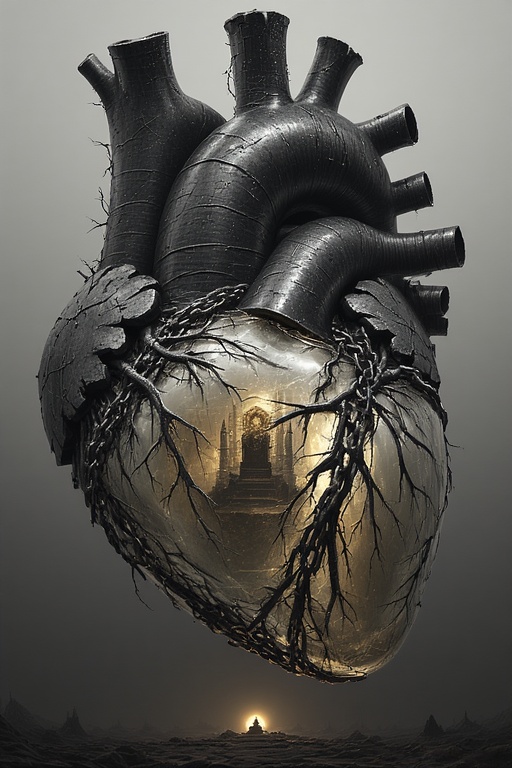
    The Silent Coup: When the Heart Becomes a Throne of Desire


    In the vast landscape of the human spirit, the heart is often imagined as a sacred space—a garden of affections, a wellspring of loyalty, a quiet sanctuary where we commune with the divine. It is the seat of our truest self, the moral and emotional compass that guides our journey. But what happens when this sacred space is seized? What happens when the rightful ruler is exiled, and a tyrant takes its place?


    This is the chilling premise at the heart of “The Law of Idolatry,” a profound theological text that diagnoses the mechanics of our spiritual undoing. Its opening salvo, Section 1.1, is not merely a chapter heading but a declaration of war, a poetic prophecy of a fall that begins not with a bang, but with a silent coronation in the deepest chambers of the soul. It reads:

    “The Heart shall become the Throne of Desire, and the soul shall bow to its cravings.”

    This single, haunting line reframes the entire human condition. It marks the beginning of the descent, the precise moment when the internal kingdom is overthrown. It’s a coup d’état so subtle, we are often its last and most oblivious victims. Let’s unravel the profound and terrifying truth of this first law.

    The Coronation of Craving: A New Monarch


    The language here is deliberate and potent. The heart is not a mere vessel for emotion; it is a Throne. A throne implies sovereignty, rule, and ultimate authority. It is the seat of power from which all decrees for the kingdom of the self are issued. Historically, this throne was meant to be occupied by something transcendent: Covenantal Love, Divine Truth, or selfless commitment. It was a place of allegiance to a reality greater than our own fleeting appetites.


    But Section 1.1 describes a usurpation. The new monarch is Desire.


    In this new regime, Desire is no longer a servant or a signal—a healthy impulse that points us toward goodness, beauty, or God. Instead, it becomes the source of law itself. The fundamental question of the heart shifts from “What is true? What is right? What is loving?” to the far more immediate and seductive question, “What do I want?”

    This is the essence of idolatry. It is not just the worship of a golden calf or a stone statue; it is the deification of appetite. Craving is no longer a response to be interrogated, disciplined, or aligned with a higher purpose. Craving becomes the purpose. The soul, once the wise counsel and high priest of the heart, is forced to abdicate its role. It is no longer a discerner of spirits but a servant of impulses. Its new and only job is to procure for the new king whatever it demands. “The soul shall bow to its cravings” is a portrait of complete spiritual enslavement. The will, the intellect, and the spirit become mere functionaries in a kingdom ruled by want.

    The Psychological Anatomy of the Fall


    This spiritual coup has a distinct and observable psychological anatomy. It is a slow, methodical rewiring of our internal operating system, moving us from a state of groundedness to one of perpetual unrest. The law identifies several key shifts in this process.


    1. From Covenant to Craving


    A heart governed by covenant is a heart defined by promise and presence. It operates on principles of faithfulness, loyalty, and steadfast love. It asks, “To whom do I belong?” and “What are my commitments?” Its fulfillment comes from reliability and relational depth. It is the sturdy, deep-rooted oak, drawing life from a source beyond its own leaves.

    A heart governed by craving, however, is defined by absence and appetite. It operates on principles of acquisition and consumption. It asks, “What can I get?” and “What will make me feel good right now?” Its fleeting satisfaction comes from the temporary filling of a void. It is the tumbleweed, blown about by every gust of wind, rootless and perpetually seeking a place to land, but finding none. This shift replaces the stability of belonging with the frantic energy of wanting.


    2. Satisfaction Over Sanctification


    When Desire is king, the kingdom’s highest value is satisfaction. The goal is to quell the immediate ache, to silence the gnawing emptiness, to find a quick hit of pleasure, approval, or comfort. This is the logic of the addict, the consumer, the approval-seeker. The solutions it offers are always external and immediate: a new purchase, another drink, one more “like” on social media, a fleeting romantic encounter.


    This pursuit of satisfaction comes at the expense of sanctification. Sanctification is the slow, often uncomfortable process of becoming whole. It is the journey of healing, maturing, and being made holy—set apart for a higher purpose. It requires patience, discipline, and the willingness to endure temporary discomfort for the sake of long-term transformation. It is the difference between eating junk food for a momentary sugar rush and cultivating a diet that builds lasting health. The enthronement of Desire convinces us that the short-term fix of satisfaction is preferable to the arduous, life-giving journey of sanctification.


    3. The Great Misinterpretation: Mistaking Longing for Love


    At the core of our being is a profound, God-given ache for intimacy, for union, for being truly known and loved. This is one of the most powerful and sacred forces within us. But under the rule of Desire, this holy longing is tragically misinterpreted. The deep, existential ache for communion with the divine and with others is reduced to a raw neediness that must be pacified.

    The heart, now a throne of craving, redirects this ache toward idols that promise immediacy. The longing for true, covenantal love is channeled into the pursuit of lust or romantic fantasy. The longing for genuine community is replaced by the hunt for social validation. The longing for transcendent purpose is supplanted by the relentless drive for career success or material wealth.

    Idols are masters of the immediate. They offer a simple transaction: “Bow to me, and I will give you a feeling of fullness right now.” They cannot deliver on true, lasting intimacy, but they are experts at providing a convincing counterfeit. We mistake the intensity of our desire for the authenticity of the object we desire, and we end up worshiping a shallow promise because we are unwilling to wait for a deep reality.


    4. The Soul in Chains: The Loss of Agency


    The final and most tragic consequence of this internal coup is the subservience of the soul. A healthy soul possesses agency and discernment. It can weigh consequences, align actions with values, and say “no” to the heart’s destructive impulses. It is the steward of the inner kingdom.


    But when Desire is king, the soul becomes a slave. It loses its power to discern, its freedom to choose. Its primary function becomes strategic: How can I get what the king wants? It will rationalize, justify, and scheme to satisfy the heart’s cravings. It will convince you that the toxic relationship is passionate, that the crushing ambition is noble, that the mindless distraction is a well-deserved rest. The soul, which was meant to be the guardian of the throne, becomes the enforcer of the tyrant’s will.


    Ancient Echoes: The Scriptural Blueprint for the Usurped Throne


    This “Law of Idolatry” is not a new revelation but a modern articulation of an ancient, biblical truth. The scriptural writers were masterful diagnosticians of the human heart, and their words serve as powerful anchors for this principle.


    Jeremiah 17:9 – “The heart is deceitful above all things and desperately sick; who can understand it?”


    This is perhaps the most direct scriptural parallel. The prophet Jeremiah warns us that the heart, left to its own devices, cannot be trusted as a benevolent ruler. It is a natural-born liar. Its deceit lies in its ability to convince itself that what it craves is what it truly needs. A deceitful king will always lead his kingdom to ruin, cloaking destructive policies in the language of freedom and fulfillment. This is why the unexamined heart is such a dangerous place; its throne is built on a foundation of self-deception.


    Romans 1:24 – “Therefore God gave them over in the lusts of their hearts to impurity, to the dishonoring of their bodies among

    themselves.”


    The Apostle Paul introduces a terrifying theological dimension to this process. The enthronement of Desire is not just an act of human will; it can also be an act of divine judgment. Paul describes a point where, after humanity has repeatedly chosen the idol over the Creator, God “gives them over.” This is not an active punishment, but a passive release. It is the moment God respects our terrible choice and allows the usurper king to have his way. The throne we have so desperately built for Desire is finally and fully handed over. The natural consequences of a kingdom ruled by craving—impurity, dishonor, disintegration—are allowed to run their course.


    Ezekiel 14:3 – “Son of man, these men have set up their idols in their hearts, and put the stumbling block of their iniquity before their faces.”


    Ezekiel pinpoints the precise location of the crime scene: the idols are set up in their hearts. This confirms the central thesis of Section 1.1—idolatry is an inside job. The external acts of worship are merely the final symptoms of a disease that has already festered internally. The throne is built in silence, brick by brick, with each small compromise, each unchecked fantasy, each cherished resentment, each prioritized ambition. It is constructed in the unseen chambers of our affections long before the rest of the world sees the flag of our new king flying from the castle walls.


    Reclaiming the Throne Room


    The First Law of Idolatry is a grim diagnosis, but it is not a death sentence. It is a map that shows us where we went wrong. It tells us that the primary battleground for our souls is not in our external behaviors, but in the allegiances of our hearts.

    The throne was built in silence, and it is in silence that it must be dismantled. It requires the courageous work of self-examination, of asking the hard questions: Who, or what, truly rules me? What are the cravings to which my soul instinctively bows? What promises of immediate satisfaction have I accepted in exchange for the slow work of sanctification?

    Reclaiming the throne room of the heart is the great work of the spiritual life. It is the act of deposing the tyrant of Desire and inviting the true King of Covenantal Love to return. It is a slow, deliberate revolution fought not with swords, but with prayer, repentance, and the reorientation of our deepest affections.


    The most important question we can ever ask ourselves is not what we desire, but who sits on the throne of our heart. For where the king sits, the entire kingdom follows.

     

    Sincerely,
    David Kitchens, The Inner Lens


    Author’s Note: Once I finish working through the Law of Idolatry, the full paper will be shared. For now, only parts may appear—these are not the final form, just pieces along the way.


  • The Perils of Self-Centered Speech

  • When one hears the word “idolatry,” the mind often conjures archaic images: a golden calf gleaming in the desert sun, stone-carved deities in a forgotten temple, or ancient tribes bowing to totems of wood and clay. It feels like a relic of a bygone era, a primitive spiritual error that has long since been corrected by enlightenment and modernity. We, in our sophisticated age, are surely past such things.


     

    But what if idolatry is not primarily about the object of worship but the act of it? What if the shrine was not built of stone, but of hopes and fears? What if the spirit behind it is not an ancient deity, but a modern emotional dependency? This is the landscape we will explore—the subtle, insidious, and deeply personal nature of idolatry as an emotional vice. This spiritual condition begins not in a temple but in the quiet, desperate chambers of the human heart.


    Reframing the Shrine: From False Gods to False Anchors


    To understand modern idolatry, we must first redefine it. It is not merely the worship of a false god; it is the act of giving ultimate loyalty, devotion, and trust to anything other than the one true God. It is the elevation of a created thing to the place of the Creator. The Apostle Paul articulated this with breathtaking clarity, writing that humanity “exchanged the glory of the immortal God for images made to look like a mortal human being and birds and animals and reptiles” (Romans 1:23).


    Paul’s indictment was not just against those carving statues. His diagnosis cuts to the core of the human condition: we have a deep-seated tendency to trade the infinite for the finite. We take something good, tangible, and immediate—like love, security, success, or acceptance—and we give it a weight it was never designed to bear. We turn a gift from God into a god itself.


    The modern idol is rarely a physical object we bow down to. Instead, it is a concept, a relationship, a status, or an ideal that we anchor our emotional and spiritual lives to. It becomes the source of our identity, the measure of our worth, and the center of our meaning. The career becomes more than a job; it is our validation. The romantic partner becomes more than a companion; they are our savior. The bank account becomes more than a resource; it is our security. These are not shrines of wood and stone, but shrines of the heart, and the worship is conducted not with chants and sacrifices, but with anxiety, obsession, and relentless striving.


    The Emotional Anatomy of Idolatry: Longing, Devotion, and Misplacement


    Idolatry is not a sudden spiritual failure; it is a slow, creeping process rooted in the very fabric of our emotional being. Its anatomy can be broken down into three essential parts: longing, devotion, and misplacement.


    1. The Universal Longing: Every human soul is born with a profound ache, a deep and persistent longing for meaning, security, love, and purpose. It is a spiritual vacuum, a “God-shaped hole,” as some have called it. This longing is not a flaw; it is by divine design. It is the homing signal embedded within us, meant to draw us toward our Creator, the only one who can truly satisfy the depths of our desires. We long to be known, to be safe, to matter. This is the raw fuel of all worship.


    2. The Natural Engine of Devotion: This innate longing naturally produces devotion. We are creatures of worship; we cannot help but devote ourselves to something. That which we believe will fill our emptiness, secure our future, or define our identity will inevitably receive our time, our energy, our money, and our emotional bandwidth. Devotion is the engine that drives us. It is the act of focusing our life’s resources and affections on a chosen center. Where your treasure is, Jesus said, there your heart will be also. What we devote ourselves to is what we worship.


    3. The Tragic Misplacement: Herein lies the birth of idolatry. The tragedy is not the longing or the devotion, both of which are natural and God-given. The tragedy is their misplacement. Instead of directing our deep longing and powerful devotion toward the infinite God who designed them, we divert them onto a finite, created thing.


    We take our longing for unconditional acceptance and misplace it onto the approval of our peers or the affection of a partner. We take our longing for ultimate security and misplace it onto our financial portfolio or our career trajectory. We take our longing for righteousness and misplace it onto a political ideology or a social cause.


    The object of our devotion promises to fill the void, but it is a false promise. A career cannot grant ultimate worth. A person cannot provide ultimate security. Money cannot buy ultimate peace. When we ask a created thing to do what only the Creator can, it will inevitably collapse under the weight of our worship, leaving us more empty and afraid than before. This is the cruel cycle of idolatry: it promises everything and delivers only bondage.


    The Mythic Metaphor: The Maskmaker’s Shop


    To grasp the spirit behind this insidious process, consider a mythic metaphor: the story of the Maskmaker.


    Imagine a world filled with faceless people. They wander in a gray, formless landscape, each one aching with a nameless insecurity. They know they are supposed to have an identity, a purpose, a face that is uniquely their own, but they feel like blanks, invisible, and insignificant.


    In the heart of this desolate land stands a quiet, unassuming shop. The sign above the door simply reads, “The Maskmaker.” Its proprietor is a master craftsman, but his trade is not in wood or clay. He is a purveyor of identity.


    A faceless person, desperate for meaning, stumbles into the shop. The Maskmaker, with a knowing and sympathetic smile, listens to their deepest longings.


    “I feel weak and powerless,” the person whispers. “Ah,” the Maskmaker says, reaching for a polished mask from a high shelf. “Then you need this.” He presents the Mask of Power. It is sleek, confident, and intimidating. “Wear this, and no one will ever mistake you for weak again.”


    “I feel unloved and unseen,” another confesses. The Maskmaker nods, retrieving the Mask of Desirability. It is beautiful, captivating, and alluring. “Wear this,” he promises, “and you will never be lonely again.”


    For every longing, he has a mask: the Mask of Success, the Mask of Intelligence, the Mask of Righteousness, the Mask of Wealth, the Mask of Victim-hood. He doesn’t ask for payment in coins. The price is far more subtle. He asks only for their devotion.


    “To keep the mask’s power,” he explains, “you must serve it. You must polish it daily with your thoughts. You must protect it with your actions. You must prioritize its maintenance above all else. Your life must become about preserving the identity the mask gives you.”


    Eagerly, the person agrees. They put on the mask, and the transformation is immediate. The world sees them differently. They are now “The Successful One” or “The Beautiful One.” They feel a rush of validation, a sense of self they never had before.


    But over time, a strange and terrible thing happens. The mask begins to fuse with their skin. The identity it provided becomes the only identity they know. Their life’s purpose shrinks to the singular task of upholding the image of the mask. The successful person lives in terror of failure. The desirable person lives in constant fear of aging or rejection. The powerful person becomes paranoid, obsessed with maintaining control.


    They have become enslaved to the very thing they thought would set them free. They have forgotten they ever had a real face underneath. The mask, their chosen idol, now owns them.


    This is the spirit behind the shrine. Idolatry offers us a shortcut to identity. It preys on our deepest insecurities and offers a counterfeit solution in exchange for our worship. It promises to name us, but in the end, it only erases us, trapping us behind a facade that demands our entire life to maintain.


    Keeping Ourselves from Idols


    The final command in the Apostle John’s first letter is as tender as it is stark: “Little children, keep yourselves from idols” (1 John 5:21). The phrasing is significant. It is not the harsh command of a distant king, but the urgent, loving plea of a father to his beloved children. He knows their—and our—propensity to wander, to seek comfort and identity in the Maskmaker’s shop.


    “Keeping ourselves” is an active, ongoing vigilance of the heart. It requires us to become attuned to our deepest longings and to ask the difficult questions:


    When I am stressed, afraid, or ashamed, where do I instinctively run for comfort?

    What success do I daydream about that I believe would finally make me feel whole and happy?

    What failure or loss do I fear so much that my life would feel over if it happened?

    What do I sacrifice my time, my integrity, or my relationships for?


    The answers to these questions do not point to sticks and stones. They point to the hidden altars in our hearts. They reveal the masks we are tempted to wear.


    The journey away from idolatry is not about finding a better mask or simply smashing the old one. It is the slow, courageous, and grace-filled process of taking the mask off. It is about turning away from the counterfeit identities offered by the world and rediscovering the true face given to us by our Creator—the face of one made in His image, beloved and known by Him.


    The spirit behind the shrine is a spirit of exchange, offering a tangible but temporary identity for an eternal and true one. Our task, in this first week and beyond, is to recognize the transaction for what it is and to guard our hearts, ensuring our deepest longings and most powerful devotions are aimed not at the created but at the Creator who alone is worthy of them.


    Respectfully and Sincerely,
    David Kitchens, The Inner Lens

  • Ghosts In The Mirror
    A Fragmented Soul’s Lament

    The Man in the Mirror:

    A Journey Back to Self

    Ghosts In The Mirror

    In the silent wreckage of who I was,
    I sift through remnants, cold and gray.
    A crown of ash, a throne of dust,
    Once solid truths now slip away.

    Chasing shadows that dance and flee,
    Like Ghosts that mock my every stride.
    Fragments of me, sharp and unclear,
    Their whispers echo – Truth denied.

    It was a simple act—walking into the bathroom and shutting the door—but it felt like crossing a threshold. The muted hum of the fan filled the silence, a backdrop to the dull fluorescent light that flickered overhead. For a moment, I stood there, motionless, the cold tile beneath my feet grounding me to a reality I couldn’t quite accept. Slowly, I raised my head to face the mirror.

    The man staring back at me wasn’t just unfamiliar; he was a stranger cloaked in exhaustion, his hollow eyes avoiding their own reflection. Behind those eyes lay years of erosion—of my confidence, my instincts, and my very identity. She had questioned every decision I’d ever made, her voice weaving doubt into my mind with the precision of a needle. It wasn’t just doubt, though. It was the half-truths, the subtle barbs, and the quiet manipulation. They worked together like acid, eating away at the fiber of who I once was until there was little left to hold onto.

    Looking at this stranger, I saw the consequences of a relationship built on control and veiled contempt. I saw the man who had silenced his voice, dismissed his own opinions, and reshaped his very being to fit someone else’s mold. The vibrant hues of my individuality had been slowly drained, leaving behind a monochrome image of compliance.

    Awareness crashed over me, sharp and relentless, stealing the breath from my lungs. Exhausted and disoriented, he fought to navigate through the thick fog that enveloped him, smothering any sense of direction. Doubt crept in like the mist, clinging to his every thought, clouding his instincts. Years of slow disillusionment had worn me down, leaving me exposed and vulnerable, questioning the very essence of ;who I was.

    I leaned forward, gripping the sink as if it might anchor me, and whispered, “Who am I?” The question hung in the air, unanswered by the silent stranger in the mirror. But even as the despair threatened to consume me, a tiny spark of hope flickered within. The act of recognizing the problem, of acknowledging the damage done, was the first step toward recovery. The journey back to myself would be long and arduous, but it started here, in this small, sterile bathroom, with a simple question and a silent plea to rediscover the man I used to be.

  • The Dance of Futility: When to Step Away


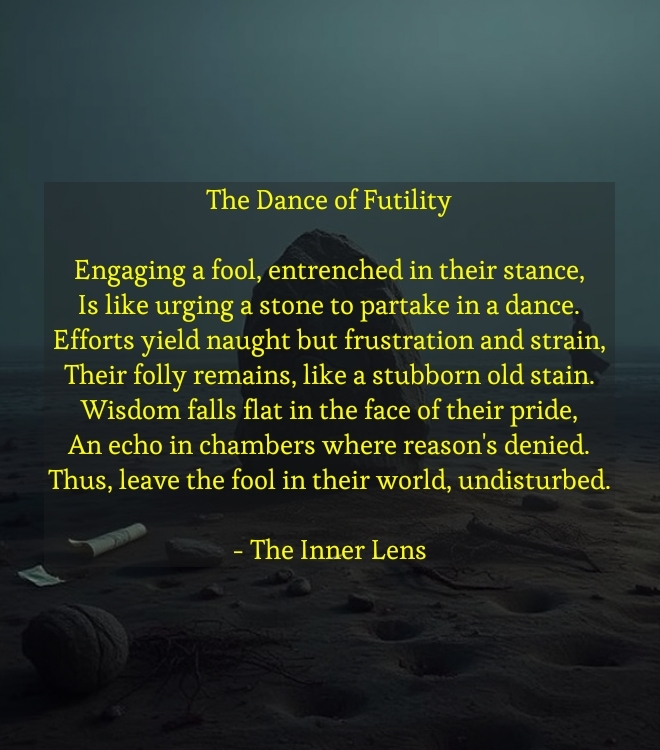
    The Dance of Futility: Recognizing When to Retreat


    We’ve all been there: Engaged in a heated discussion with someone who appears completely resistant to logic, stubbornly holding onto their stance with the same unyielding determination as a barnacle clinging to a ship’s hull. You present facts, logical arguments, and perhaps even a touch of empathy, but they resist, deflect, and may even become hostile. This, my friends, is the dance of futility, and it’s a dance we’re often better off sitting out.


    The core of the issue lies in the inherent resistance to change within someone deeply entrenched in their beliefs. As the poem suggests, engaging with such a person is akin to trying to coax a stone into dancing. No matter how eloquent your movements or how persuasive your music, the stone will remain unmoved. You spend your energy fruitlessly, leaving yourself depleted and frustrated.


    This isn’t merely about disagreeing with someone. Disagreement is a healthy part of discourse, a vital component of growth. It’s about encountering a level of inflexibility that transcends genuine debate and enters the realm of entrenched folly. People dismiss evidence, ignore logic, and replace rational argumentation with personal attacks.


    In these situations, even the most well-intentioned attempts at wisdom fall flat. Your insights become mere echoes in the desolate chambers of a closed mind. The problem isn’t your message; it’s the impenetrable barrier of pride and preconceived notions.


    Why, then, do we persist? Perhaps we hope to reach a breakthrough, to plant a seed of doubt, to penetrate the armor of their conviction somehow. Maybe it’s a desire to "win" the argument, to prove our point, to feel validated. But continuing the engagement in the face of such entrenched resistance is often an exercise in self-inflicted pain.


    The poem offers a simple yet profound solution: "Thus, leave the fool in their world, undisturbed." This isn’t about condoning ignorance or shirking responsibility. Recognize when you’re wasting your efforts and redirect your energy towards more productive pursuits.


    Sometimes, the most courageous and intelligent thing we can do is to step away. To acknowledge that some battles are unwinnable and to prioritize our own well-being. Let the fool reside in their undisturbed world, content in their convictions. You, meanwhile, can seek out fertile ground where your words might actually take root and blossom.


    This isn’t an endorsement of apathy, but rather a call for mindful engagement. Choose your battles wisely. Invest your time and energy where it has the potential to make a difference. And when you find yourself amid the dance of futility, remember the unmoving stone and gracefully exit the stage.


  • Healing Through Reflection: A Tale of Renewal

    The Call of Reflection

    John sat in his small, sparsely furnished apartment, staring blankly at the walls that felt both unfamiliar and suffocating. He had recently divorced after 17 years of marriage. The union had felt more like a battlefield than a partnership. In the quiet aftermath, he was left to confront a life that felt hollow and undefined.

    For 17 years, his identity had been wrapped up in a relationship that was marked by conflict and strife. He had lost himself in the constant battles, the relentless arguments, and the simmering resentment that had poisoned their home. Now, stripped of that identity, John felt like a ship adrift in a stormy sea. He was without a compass to guide him.

    His ex-wife had made sure to alienate their children from him, a final, cruel twist of the knife. There was no contact, no shared moments, no laughter echoing in the halls. The silence was deafening, the loneliness, a heavy burden he struggled to bear. The absence of his children left a void that he didn’t know how to fill.

    Suddenly, the harsh ring of the phone cut through the oppressive quiet, jolting him from his thoughts. He reached for it, his heart pounding with a mix of hope and dread. Is it one of his children? Is it the lifeline he so desperately needed?

    “Hello?” he answered, his voice trembling.

    “Dad,” came the voice of his son, cold and distant. There was no warmth, no affection. Just the simmering anger that had been festering for too long.

    “Yes, son?” John replied, his heart aching at the sound of the voice he had missed so much.

    “I just wanted to let you know how much I hate you,” his son spat, the words like daggers. “You ruined everything. You ruined our family.”

    John felt a lump rise in his throat, the pain of the accusation cutting deep. He wanted to defend himself, to explain, to make his son understand. But the words wouldn’t come. Instead, he took a deep breath, recalling a piece of wisdom he had recently found solace in:

    Gathering of the Faithful

    Blessed are those whose ways are true, Who walk with light, their hearts renewed. In Your decrees, they forge their path, With steadfast faith, they greet each day. In blameless steps, the journey grasps.

    John reminded himself that this was a time for reflection and growth. He does not control the past, but he can choose how he responded now. He remembered the teachings of compassion and understanding, and how love cover even the deepest wounds.

    Your hands have shaped my very core, In Your commands, I seek and soar. Grant me wisdom, pure and bright, To walk with You in sacred light. In Your embrace, my spirit roars.

    Taking another deep breath, he spoke softly, “Son, I know you’re hurt. I know things have been difficult. But I love you, and I’m here to listen.”

    His son’s response was harsh, but John held his ground, choosing love over conflict. He hoped that, over time, this approach would plant seeds of healing and reconciliation. As the call ended, John felt a mix of sorrow and hope. It was a small step, but a step nonetheless.

    In fellowship, our hearts unite, With shared belief, on You we dine. In faith and hope, our voices rise, In unity, we sing Your praise. In understanding, love ignites.

    John knew the journey ahead would be long and fraught with challenges. He believed he rebuild his life with faith and perseverance. One day, he will mend the broken relationships with his children.

    Your laws are just, Your ways are clear, Through trials deep, You draw us near. In affliction’s heat, we are purified, Your grace and love keep us alive. Your righteousness, we hold dear.

    John embarked on his path of healing and self-discovery. He was guided by the hope that love indeed covers all wrongs. He believed that peace and understanding be found even in the midst of life’s greatest trials.